When More Amenities Make a Venue Harder to Read
A casino venue directory helps visitors compare dining, lounges, events, and services by purpose, so they can choose where to go without decoding venue jargon.
You open a casino venue directory in Tân Bình looking for dinner and meet a list of restaurants, bars, lounges, event rooms, and guest services. A useful casino venue directory helps you compare what each place is for, not merely how many places the venue can name.
That distinction matters when options overlap. A cocktail bar may serve food; a lounge may host gatherings; an event room may be unavailable to walk-ins. Clear categories and candid descriptions help visitors choose without treating the directory like a map of every door in the building.
Which choices should the directory organize?
Start with visitor-facing purposes: dining, drinks and social spaces, entertainment, events, and guest services. Use only categories that match amenities the venue actually offers. An empty category is not an invitation to imagine a facility into existence.
Keep each place in one primary category. If a cocktail bar serves small plates, describe that in its entry instead of duplicating it under dining. Cross-links can connect related options, but the listing should still make clear that both descriptions refer to the same place.
Categories should also reflect how visitors decide. A person choosing a meal needs to distinguish a full-service restaurant from a café or a bar serving small plates. Someone planning a gathering needs to know whether a room is an event space and what access conditions apply.
How can listings distinguish similar venues?
What should a dining description say?
Name the format in plain language: full-service restaurant, café, or drinks with small plates. If the venue can confirm other useful details, include them, but do not use a branded name as a substitute for explaining what is offered.
How should a lounge and a bar be described?
Describe the actual use, such as a place to sit and talk or a bar focused on drinks. Include food availability only when confirmed. If the venue cannot substantiate a claim that one space is quieter or more social than another, leave that distinction out.
When is a room an event listing?
Keep event spaces separate from scheduled entertainment. Say whether the room is open to visitors or requires a booking, and present a specific performance as an event rather than a permanent amenity.
Where do practical services belong?
Put confirmed help, such as an information desk or accessibility assistance, under guest services. Visitors looking for practical support should not have to sift through dining and entertainment entries to find it.
What details help visitors compare venues?
Give each entry a short description of its purpose and its most useful confirmed distinction. Put booking, event, and access conditions beside the relevant listing, where a visitor can see them while making a choice.
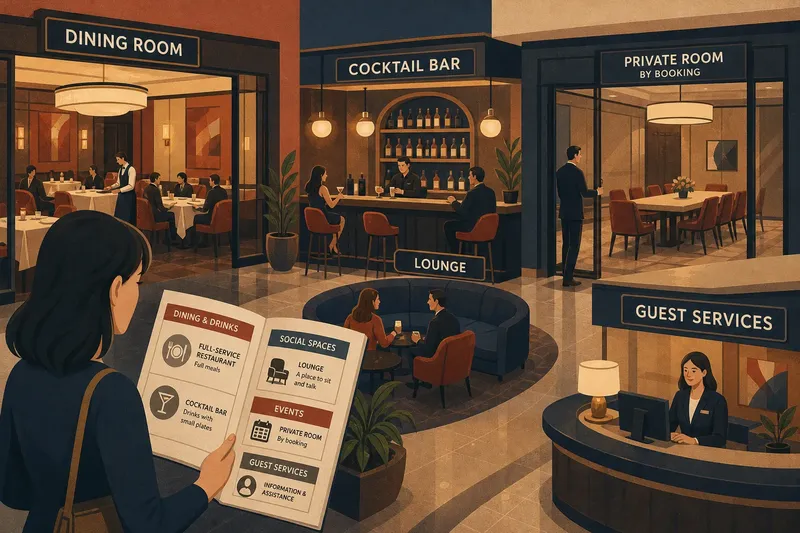
Imagine a venue editor has four confirmed spaces: a full-service dining room, a cocktail bar serving small plates, a lounge, and a private room available by booking. The editor places the dining room and cocktail bar in a dining-and-drinks group, with each description naming its format; the lounge goes under social spaces, and the private room goes under events with its booking condition beside the name. A visitor seeking dinner can compare the first two, while someone planning a gathering can identify the room and its access condition. The tradeoff is that the cocktail bar shares a group with the dining room, so its description must clarify that drinks, rather than full meals, are its focus.
Use plain language alongside branded names. “A dining venue for dining” adds little; “a full-service restaurant” tells visitors more. If a place has several uses, name its primary one and mention a secondary use briefly instead of making duplicate entries.
What should an editor check before publishing?
Read the directory as someone unfamiliar with the venue. For each observation, choose the action that resolves the specific confusion; if the problem is absent, keep the simpler version.
- Observation: visitors cannot tell which listings offer meals and which are mainly social spaces. If the formats are unclear, separate the categories and state each format; otherwise, keep the grouping and retain a plain description for every entry.
- Observation: one place appears under multiple categories and could look like several destinations. If the duplicate could mislead, keep one primary listing and add a cross-link; otherwise, leave the single entry without extra links.
- Observation: descriptions of similar options sound interchangeable. If visitors cannot distinguish them, add a confirmed difference in format or use; otherwise, keep the concise descriptions.
- Observation: a booking or access condition is separated from its listing. If a visitor could miss it, move the condition beside the entry; otherwise, keep its current placement and make the wording plain.
- Observation: practical services are buried among leisure options. If visitors must scan unrelated entries for help, create a guest-services group; otherwise, keep the existing location and label it clearly.
- Observation: a category uses internal department language. If a first-time visitor would need staff knowledge to understand it, replace it with a visitor-facing label; otherwise, keep the familiar wording.
Say an editor sees “Guest Operations” containing an information desk and a restaurant booking link. The editor moves the desk to “Guest Services,” keeps the booking link with the restaurant, and reads both labels as a visitor would. The resulting directory separates a request for help from a dining choice, without adding a catch-all category for unrelated links.
What should you look for in a casino venue directory?
How can I tell whether a listing is a restaurant or a bar?
Look for a plain description naming the format, such as full meals, café fare, or drinks with small plates. If the venue name is unclear, the category and description should supply the missing context.
How can I tell whether an event room is open to visitors?
Check the listing for access or booking conditions. If it says nothing, contact the venue before making plans rather than assuming the room is open.
Where should I look for accessibility or information services?
Start with guest services or a clearly labeled help section. A directory should make practical assistance distinct from leisure options, so visitors can find it without guessing.
What makes a directory useful in Tân Bình?
For casino-style venues in Tân Bình, the useful distinctions are ordinary ones: a meal versus a drink, a social space versus a bookable room, and a guest service versus entertainment. Accurate categories do more work than a long list of attractive names.
When reviewing a casino venue directory, check that each listing states its purpose and any relevant access condition. A brief, accurate description helps visitors choose where to go; a broad heading that could mean anything merely gives them another thing to interpret.