From Gaming Room to Resort Destination
Casino resort history traces how gaming rooms joined broader visits, helping readers distinguish a town-based outing from a property that bundles leisure.
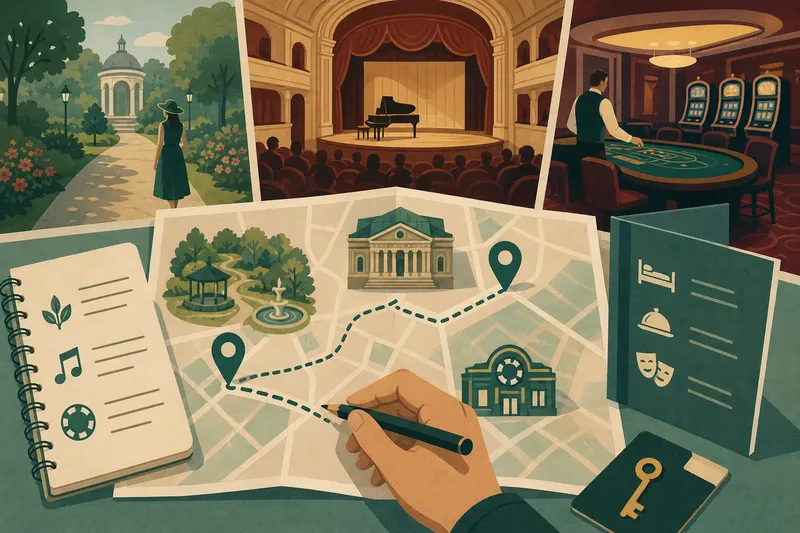
A guest finishes a garden walk, hears music from a concert hall, and then visits a gaming room before dinner. Casino resort history is easier to understand through that kind of itinerary than through the image of one enormous building.
What did early gaming rooms offer?
In parts of Europe, gaming rooms sat within established social settings rather than operating as self-contained resorts. Baden-Baden is a useful place to examine this pattern: a visitor could encounter gaming as one part of a wider spa-town visit, alongside public gathering places and other leisure activities.
Commercial gambling houses and saloons in the United States offered a different setting. Their central draw was play. Food, drink, and conversation might accompany a visit, but they did not necessarily make the venue a destination with lodging and scheduled entertainment.
The distinction is not a universal rule about every venue in either region. It is a way to ask whether a visit revolved around gaming alone or whether a town, hotel, or property connected gaming to other activities.
How did travel become part of the offer?
Some spa towns developed reputations around hotels, gardens, concerts, and seasonal social life. In that setting, gaming could be one stop in a visit assembled across the town. The destination, rather than a single building, supplied much of the itinerary.
Las Vegas offers a different history: a city whose visitor economy became closely associated with entertainment. Rather than rely on a single date or property as the moment the resort model began, it is more precise to see hotel-casinos as a pattern that developed over time. Individual buildings and opening dates belong in a sourced history, not as unsupported shorthand for a turning point.
As lodging, dining, performances, and gaming were brought together, the offer required more coordination. Visitors could plan several activities around a stay; operators had to make those activities work alongside one another.
What makes an integrated resort different?
An integrated resort deliberately places several visitor services within one property. The mix may include lodging, restaurants, theaters, meeting rooms, retail, and gaming. Guests can move among activities without treating each one as a separate destination.
Properties in different places may share that broad arrangement while having distinct histories and rules. Marina Bay Sands and Resorts World Sentosa in Singapore are often discussed as examples of large properties combining visitor facilities with gaming. A careful account should verify the details of each property and the applicable local rules before making more specific claims about their facilities or regulation.
The historical shift was not simply a matter of buildings growing larger. In some places, operators organized a visit around several connected reasons to stay. Law, transport, tourism, and available land helped shape what that arrangement could include.
Why did the resort model change the guest experience?
A gaming room chiefly had to make play accessible and keep the venue running. A resort added coordination: restaurant hours, show schedules, hotel service, entrances, and walking routes could affect one another. Guests attending a performance might crowd nearby dining, including restaurants used by people with no interest in gaming.
The audience could also have different plans. One visitor might choose a concert or meal while a companion preferred gaming. Those activities are not interchangeable, so a property needs to explain what it offers and let guests organize their time accordingly.
Say two travelers plan an overnight visit. One wants a show; the other prefers a quiet dinner. They check the published schedule, choose a performance time, reserve dinner, and confirm that the hotel and theater are on the same property. If the meal overlaps the show, they move dinner earlier or skip the performance. The observable result is a plan with a clear tradeoff: shared lodging, but either a shifted meal or no show.
How does local context change the comparison?
Resort development depends on more than an operator’s plans. Local rules shape what activities are permitted. Existing hotels and attractions affect whether a property needs to supply lodging and entertainment itself. Transport and neighborhood patterns shape whether visitors stay within one complex or combine places across a city.
This matters in Tân Bình, a district of Ho Chi Minh City. Histories from European spa towns, Las Vegas, or Singapore do not establish that the same resort format exists there. Casino-style entertainment, regulated gaming, hotels, and nearby leisure venues are distinct categories. A local description should identify the venue and its permitted activities rather than borrow a label from another market.
A useful comparison asks how a visit is assembled. A self-contained resort bundles facilities. An urban venue may rely on nearby restaurants, hotels, or event spaces. Both can support a varied outing, but their operating models and histories differ.
What questions help distinguish casino resort history?
When did casinos become resorts?
There was no single starting point shared by every place. Social settings, resort towns, and hotel-casinos followed different paths, and specific dates need reliable historical sources.
What is an integrated resort?
It is a property that combines gaming with other visitor facilities, such as lodging, dining, entertainment, or meeting space. The mix depends on the venue and the rules that apply there.
Did resort amenities replace gaming?
Not necessarily. In this model, gaming remained one part of the offer alongside other activities, with the balance varying by place and period.
Does Tân Bình have the same resort model as Las Vegas?
A historical comparison cannot establish what a local venue currently offers. Check the venue’s own information and applicable local rules before describing casino-style entertainment as regulated casino gaming or an integrated resort.
How can you compare a town-based visit with a resort property?
Imagine a visitor has a printed program listing a concert in a spa town, a hotel reservation nearby, and a separate gaming-room address. They mark each location on a paper map and check the program’s event time against the reservation details. If the venues are separate, the resulting itinerary depends on travel between them; if the visitor instead has a property plan showing the hotel, theater, and gaming room in one complex, the activities can be treated as a bundled visit. The decision is whether the destination or the property supplies the connections.
- Check whether lodging is on the same property; if it is, compare the bundled visit, and if not, plan for a separate hotel.
- Check whether dining is inside the venue; if it is, coordinate meal timing there, and if not, identify a nearby restaurant.
- Check whether performances appear on the venue’s own schedule; if they do, compare show times with meals, and if not, treat entertainment as a separate stop.
- Check whether the gaming description names permitted activities; if it does, use that precise wording, and if not, avoid calling the offer regulated casino gaming.
- Check whether meeting or event space is listed; if it is, consider it part of the property’s visitor offer, and if not, do not assume it is available.
- Check whether the surrounding town supplies additional attractions; if it does, map a town-based itinerary, and if not, compare only the facilities actually documented.
Casino resort history moves through several forms: social gaming rooms, resort towns, hotel-casinos, and integrated properties. These are comparisons, not stages every market must pass through. For Tân Bình, the useful final question is still concrete: which venue provides which activities, and does the visit depend on the property itself or on the surrounding neighborhood?