The First Five Minutes: What Makes a Venue Arrival Legible
Venue arrival cues help guests in Tân Bình find their first stop, understand how the welcome works, and settle in without guessing at every turn.
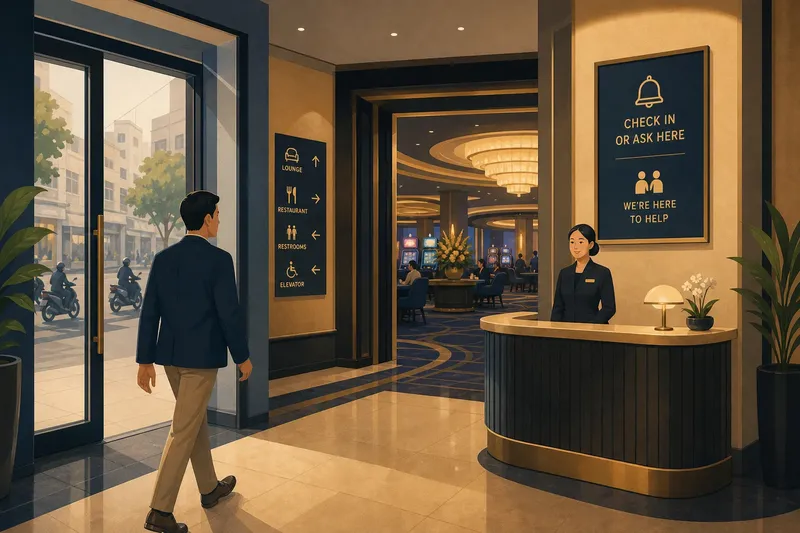
A guest steps in from a busy Tân Bình street, pauses to let the door close, then looks from a host desk to a lounge entrance. Clear venue arrival cues help that guest tell which place is meant for visitors and what to do there. They also let the lobby feel like a lobby, rather than a small examination in local architecture.
For a casino-style entertainment venue, arrival is part of the guest experience before any leisure activity begins. The entrance should offer a calm first impression, identify the visitor’s first stop, and make help easy to request. That can be done with a host, a concise sign, or both, depending on how the space works.
What should venue arrival cues tell a guest?
A visitor arriving from a hotel, office, restaurant, or nearby street does not automatically know the venue’s routine. At the threshold, the useful information is simple: this is the visitor entrance, this is where to check in or ask, and this is how to continue afterward.
Use familiar visitor-facing language such as “Reception,” “Check in,” or “Ask here.” Avoid department names that only make sense to staff. If the guest must present a reservation or wait for an escort, state that plainly at the point where the action is expected.
The entrance should also make its basic route understandable to someone who cannot comfortably use stairs or approach a high counter. Keep the accessible path clear and make assistance available without requiring a guest to cross the lobby first. For specific access arrangements or local requirements, consult qualified accessibility guidance and applicable rules.
What should the entrance communicate visually?
Give the visitor one obvious place to begin. A reception desk visible from the entrance, a host positioned beside it, or a direct sign toward the first stop can do the work. Avoid competing displays that make the visitor wonder whether the promotional stand, lounge, or counter is the actual welcome point.
Place signs where a guest can read them before reaching the choice they explain. Keep wording consistent from entrance to desk and onward. If a map is useful because destinations are spread across the venue, put it somewhere a visitor can pause without blocking the doorway.
In a multilingual setting, use the languages that fit the expected visitors and keep translations aligned between signs and staff. A symbol can support a short label, but should not replace words that explain an unfamiliar process.
How can a host make arrival easier?
A host can adapt a greeting to the guest’s purpose, answer a question, or direct a group to the right area. This is especially useful when the next step depends on a reservation or when visitors have different destinations. The host’s location should be apparent without making every guest feel required to stop.
People are not permanent fixtures. A host may be assisting another party, so basic directions should remain available when the desk is briefly unattended. A visible “Reception” sign or a clear instruction to wait nearby prevents the welcome from disappearing whenever staff turn to help someone.
Signs and staff should agree. If a sign indicates one counter while a host gestures toward another, the guest has been given two instructions and no reason to choose between them.
Which arrival approach fits the venue?
When is a host-led welcome useful?
A host-led welcome suits an entrance where visitors need to explain their purpose before proceeding. Keep a simple sign or desk label in view as a backup, so a guest can identify the welcome point even while the host is occupied.
When can signs handle the routine?
Signs can handle a straightforward route when each next destination is visible or clearly named. Keep staff available for questions that the signs cannot answer, such as a reservation issue or a change of plan.
When does a blended welcome make sense?
A blended welcome works when most guests follow a routine but some need individual help. Signs explain the standard route; a host handles exceptions without turning the lobby into a queue for basic directions.
How should a venue choose its approach?
Trace the visitor’s path from the entrance to the first place they can receive service. If the route is direct, signs may carry most of the welcome; if a guest must explain a reservation or destination first, make the host easy to spot.
How can staff check whether the welcome is clear?
Notice what guests do, not just what the signs say. Repeated pauses, visitors looking back toward the door, or several people asking where to check in can point to a specific gap. The following checks connect an observation to a practical decision:
- Entrance identity: If visitors pause outside or approach a side door, make the visitor entrance more distinct; if they enter without hesitation, keep the current identification.
- First stop: If guests walk past reception and then turn back, move or clarify the reception cue; if they approach it directly, retain its position and wording.
- Host visibility: If visitors scan the lobby for staff, make the host’s location easier to recognize or add a desk sign; if they find the host readily, keep the arrangement.
- Route wording: If guests ask the same directional question after check-in, replace internal terms with visitor-facing destination names; if they continue without asking, leave the wording in place.
- Sign placement: If visitors reach a fork before seeing its direction, relocate the cue to before the fork; if it is visible in time, retain its position.
- Accessible path: If a visitor must ask how to reach the usable route, make that route easier to identify and keep it unobstructed; if it is apparent and clear, maintain the current setup.
Say a venue has three signs in its lobby: one says “Guest Services,” another says “Reception,” and a third points toward “Member Relations.” A visitor arrives to ask about a reservation and stops between the signs. The venue replaces “Guest Services” with “Check in or ask here,” places that sign above the reception desk, and asks staff to use the same wording. The observable result to look for is whether arriving visitors approach that desk without first comparing labels. If they still ask which counter handles reservations, the venue should clarify that instruction at the desk rather than add another vague sign.
How can the lobby feel calm without feeling impersonal?
Give guests room to pause and a clear way to continue. A host desk just inside the entrance can be helpful, but it should not obstruct the path or imply that every visitor must stop. A nearby seating area can offer a place to wait when its purpose is clear.
Keep promotional displays, queue barriers, and wayfinding from competing for the same attention. Put secondary information where visitors can choose to read it. The primary route should remain easy to see, even when the lobby is busy.
Good venue arrival cues make the first exchange easier for both guest and staff. In Tân Bình, a visitor may arrive carrying little context beyond an address and a booking. A visible first stop, consistent language, and a real person available for questions give that visitor a sensible way to begin.